We’re Not Down
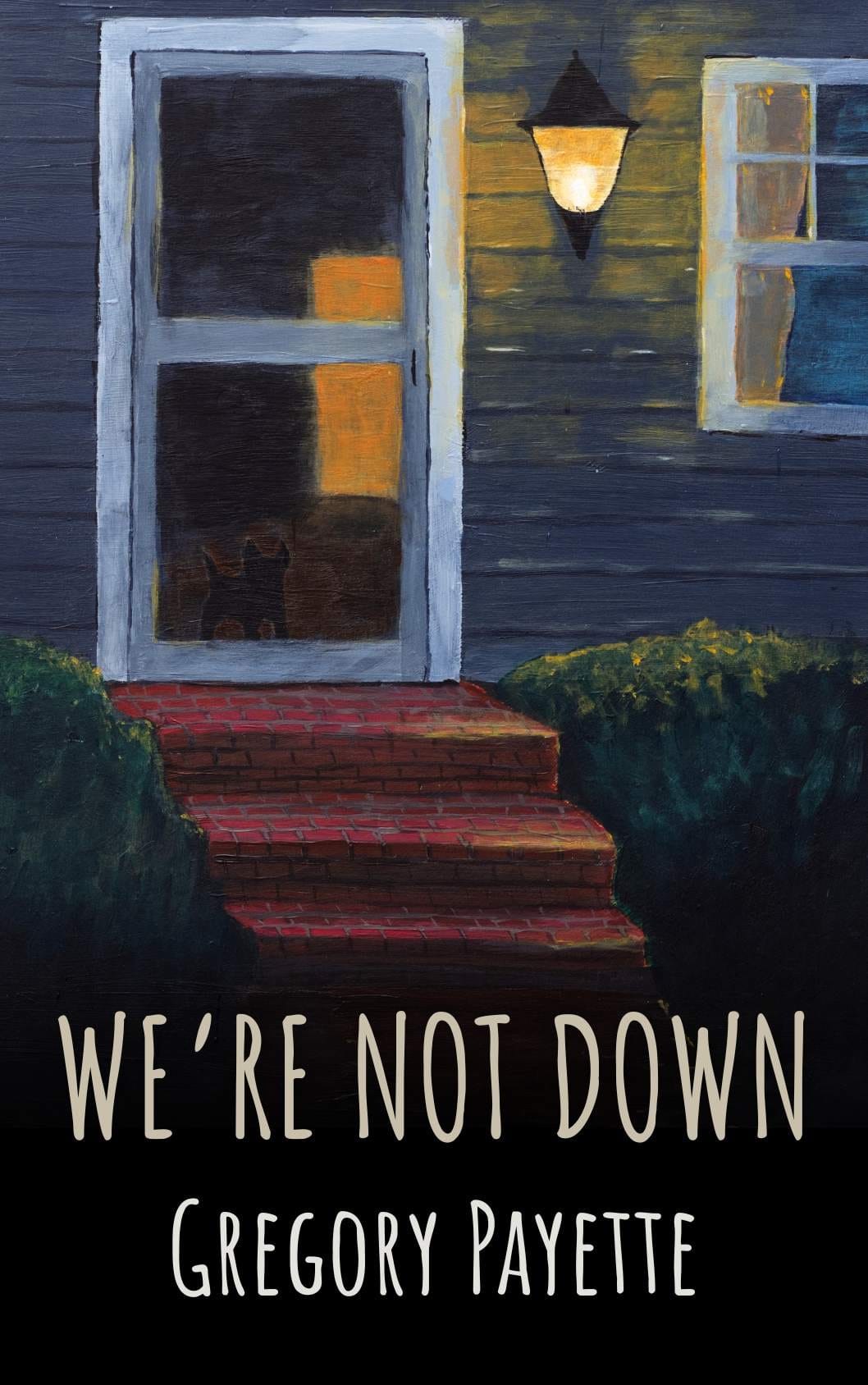
Providence, Rhode Island. August 1981.
Ted Hollis is forty-two years old, and the brewery where he spent his entire adult life just closed its doors for good.
He's got a son heading to college in a month, a rat terrier who won't stop barking, and a refrigerator with one egg in it. He's also got a letter from the financial aid office sitting on the counter that he can't quite bring himself to open—and somewhere in the back of his mind, all the roads he didn't take.
Then an old friend comes back from Los Angeles, and the life Ted had been hoping he'd one day figure out starts to get a little more complicated.
We're Not Down is a novel about a man, his hometown, and a moment when everything is ending and something else is perhaps just beginning.
Read Chapters 1 and 2 from We’re Not Down…
Chapter 1
The warm air blew in through the open driver-side window. Ted had been staring ahead at the road through his Dodge Dart’s windshield. He tightened the grip on the steering wheel, elbow resting on the open window as the wind blew his hair back.
His buddy Nick was in the passenger seat, still in uniform with his sleeves rolled up past his elbows. The patch stitched to one side of his chest said Smitty. The other had Narragansett Beer in red lettering stitched into the shirt. Nick smoked his cigarette, his third since they’d left work.
A piece of ash landed on Ted’s arm, and he wiped it off.
Neither had said a word since they left the brewery and stopped at the bank to cash their paychecks.
The radio was tuned to talk radio—WPRO. Ted reached for it to change the station, maybe put on some music, but instead turned the knob to shut it off.
Stopping at the next red light, Ted cleared his throat. “Never thought I’d see Bill Kingston crying the way he did.” He glanced at Smitty, who was looking the other way now, out the passenger window.
But when Smitty turned and gave Ted a quick glance, it was obvious Bill Kingston wasn’t the only man who couldn’t hold back his tears.
“It sucks,” Ted said. “Twenty-three years of our lives. That’s a long time.” He paused, making sure he didn’t say something foolish. “It was our home. I mean, to a lot of us it was.”
Smitty took a drag from his cigarette, then flicked it out the window. “I never thought it was really gonna end. Not the way it did.” He held his gaze on Ted. “You think we’ll ever find anything like it again? The way we all were, working together all those years?”
Ted thought about it, then shook his head. He kept his eyes on the road when the light turned green. “I always thought one day I’d leave, for one reason or another. But I assumed it would’ve been on my own terms.” He could feel Smitty watching him.
“But they were good to us for a while, don’t you think?”
“Yeah, of course. I’m just saying, I don’t know… I guess I never thought I’d work for the same company my whole life. I had other things I thought I’d do. But now, here I am, wondering what the hell comes next.”
At one time, back in ’69, Ted had been offered a job at the Providence Journal. Like most people who worked there, or were lucky enough to be offered jobs, he had a relative—an uncle—who worked in the composing room. But Ted had just been promoted to supervisor at the brewery, so it wouldn’t have made much sense to leave. But he thought about what he’d passed up all those years ago. A time came when he realized brewing beer was something that could one day come to an end. Or how production could get move to another city, the way it had. But if he’d taken the job at the Journal, he wouldn’t have had to worry. It wasn’t as if newspapers would ever go away.
Ted cut the wheel for the Route 10 exit, headed toward Warwick. He gave Smitty a look and saw that his eyes were so red it was as if he’d been drinking all day. But Ted knew he hadn’t been, because there wasn’t any beer left at the brewery for them to drink.
And it wasn’t like the old days, when they could drink on the job. Within reason, of course. Back then, every man and woman employed by Narragansett Brewery had to know the beer going out the door was as good as it could’ve been. But that was long before the brewery was bought out, and the cost cutting had changed everything. Once the new management pulled the plug on advertising and sponsorships, such as when the one with the Red Sox came to an end, every brewery employee knew it was only a matter of time.
But it didn’t matter whether they all saw it coming or not. The end still came as a shock, as if nobody ever wanted to admit to themselves it was over.
Ted turned the radio back on and an ad for Cardi’s furniture was on. Salty Brine’s voice came through the speakers on the door: “Nobody beats Cardi’s. No-ho-ho-body.”
Ted turned up the volume when Davey Jones came on after the commercials and said something about Governor Garrahy: “The Governor will have a press conference at six o’clock this evening to discuss the closing of the Narragansett Brewery in Cranston. He is expected to address the impact the closure will have on local jobs and businesses, and Rhode Island’s overall economy. Tune in for the Governor’s address right here on W-P-R-O AM 630 at six o’clock.”
Ted shook his head in disbelief, then reached for the FM button. “In the Air Tonight” by Phil Collins played, and Ted lowered the volume until he could barely hear it.
Smitty said, “You’re the only one who… I told you already, you won’t have any trouble finding work, being a supervisor and all. You’ve got a leg up on a lot of people.”
Ted had thought about that already, plenty of times. But he wasn’t sure how accurate it was. He hadn’t spent much time looking for work, even though he knew how close it was to being over. He instead put all he could into making sure things went smoothly the last few months the brewery was still open. Tensions were always high once word got out they were moving. So many employees wanted to walk out, or threatened to destroy the place. And Ted felt it was his job to make sure cooler heads prevailed, when possible.
But he knew it’d been a mistake keeping his head in the sand. He barely skimmed the Journal’s Help Wanted section on Sundays, as if he’d hoped the plans would change, and the brewery would somehow stay open.
He knew better.
Ted took the Post Road exit and said to Smitty, “You know there are close to six hundred people out there looking for work? How many people do we know who’ve already been laid off? And who knows what else is going to shut down in the coming months, the way the economy’s going?” He didn’t want to be so pessimistic. But it was hard to be any other way.
Smitty pulled another cigarette out of his pack.
Smitty’s given name was Nick. Nick Smith. But nobody called him Nick, other than Ted sometimes, and people who knew him when he was a kid would. His wife called him Nick whenever she was pissed at him for some reason, which was most of the time.
“You’re a hard worker,” Ted said. “People know that. You’ve always been appreciated. If anyone’s got nothing to worry about, it’s you.”
Smitty lit his cigarette and kept his gaze out the window for a couple of moments without a word. He grabbed the pack off the seat and held it out to Ted. “I know you quit, but it’s one of those days, you know?”
Ted put his hand up and shook his head. “I have one, I’ll have two. Next thing you know I’m stopping at the gas station to buy a pack before I get home.”
“How long’s it been?” Smitty asked.
“How long’s what been?”
“Since you quit?”
“This time?” Ted shrugged. “Three months. Well, two and a half. I mean, I’ve had a couple here and there. All the pressure at work lately and all that.” He looked at the pack in Smitty’s hand and grabbed it, tapped the bottom and let one drop on his lap. He pressed in the cigarette lighter, held his hand on it until it popped. Bringing the lighter’s bright orange glow toward him, he touched the end of the cigarette, puffing until it lit. Smoke rose from his mouth and then he inhaled, taking his first drag. An ease came over him. “Goddammit.” He looked at the cigarette, studying the smoke rising from the end. “What is it about these things, makes it so hard to give ’em up?”
Smitty didn’t answer.
The two were quiet for the next couple of miles, the radio too low to even hear the song playing now, although Ted was sure it was the Rolling Stones’ new song, “Start Me Up.” He turned up the volume as Nick had said something, then lowered it again. “What’s that?”
Smitty said, “I was just asking… Shouldn’t we stop and get a drink? Isn’t that what you’re supposed to do when you’re out of work?”
“The beers in the parking lot weren’t enough?” Ted thought about it, but shook his head. “I gotta get home.”
“For what?”
Ted couldn’t remember if Brock was working or not. And if he was at work, Ted hoped he would’ve let Rocky out back before he left. “I need to get home, make dinner.”
“We can grab something to eat at Greenfield’s. It’s Friday. Veal parm’s half price.”
The last thing Ted thought he should do was spend money eating out at a restaurant. He’d been worried for weeks, knowing he’d never saved enough, even after all those years he’d worked at the brewery. “Brock’s gotta eat.”
“He’s a big boy. He can feed himself,” Smitty said. “Besides, it’s Friday.”
Ted didn’t like anyone try to tell him how to raise his own kid, although plenty of people had tried over the years. He’d somehow managed to pull it off for eighteen years, and raised a good kid in the process.
So, when someone like Smitty—with a kid of his own who dropped out of high school, moved away, and rarely came back to visit his own parents—tried to give parenting advice, or even a subtle suggestion, it got deep under Ted’s skin.
“Bette Davis Eyes” came on the radio. He’d heard it often, but still wasn’t exactly sure who sang it. The song was all right, but mostly it reminded him of the time he took Annie to the Avon Cinema to see Bette Davis in Whatever Happened to Baby Jane.
“Come on,” Smitty said. “Let’s just stop for one.”
They were coming up to Greenfield’s, but Ted didn’t slow down.
Smitty tossed his cigarette out the window. “You used to be more fun.”
“Maybe tomorrow,” Ted said.
They drove the next couple of miles in silence, until Ted turned down Nick’s street. An airplane flew over them, and Ted leaned forward to look at it flying so low he could read Eastern Airlines on the plane’s tail. With the wheels down, the plane was going in for a landing at TF Green Airport, a stone’s throw from Smitty’s house.
Ted remembered Smitty buying the place like it was yesterday. And at the time he’d kept his mouth shut about what it would be like living next to an airport. But back then, Green was nothing more than a regional airfield. And Smitty was excited to buy a place of his own. And Smitty’s wife wouldn’t stop talking about what a good deal they’d gotten on the house.
It wasn’t even ten years later when the big jets started flying in and out of the airport. After a few beers Smitty admitted to Ted they’d made a mistake buying a house so close to the airport.
Ted pulled the Dodge Dart up to the front of the ranch home with the green siding. The grass in front was tall and needed a cut. He leaned over the steering wheel and looked up toward the sky when another passenger jet flew over them so low the car shook.
He hadn’t even noticed the blue Volkswagen Beetle parked in the driveway with the gold lettering on the dark blue license plate.
A California plate.
“Lucy’s home?” he said.
Smitty stepped out and closed the door, looking in at Ted through the open passenger window. He glanced over his shoulder and nodded. “You sure you don’t want to go grab a beer? I’ll buy.”
But Ted kept his eyes on the Volkswagen. “What happened?”
“With what?”
“Lucy?”
Smitty shrugged. “I don’t know. She just got back.”
“For good?”
“I don’t know. Why don’t you come inside and ask her yourself? I got some beers in the garage.”
The Dart was still idling, in drive, but Ted shifted into park, thinking about it. He couldn’t remember the last time he had seen Lucy, or had even spoken to her.
“I’d better just get going,” he said, shifting the car back into drive with his foot pressed on the brake pedal. He looked toward the house and peered at each window, wondering if Lucy might be looking out.
“All right,” Smitty said. “I’m going to go drink by myself then, before the wife gets home.” He started to walk away, but turned back to Ted. “You sure?”
Ted always appreciated Smitty’s persistence when it came to drinking.
“I’ll call you tomorrow,” Ted said, nodding at the tall grass with a crooked grin. “Maybe after Maryann makes you cut the lawn, we can grab a couple.”
Smitty rolled his eyes and gave Ted the thumbs-up as he turned and walked to his garage. He lifted the door and disappeared into the shadows inside.
Chapter 2
Ted walked in the front door to his mixed-breed terror barking with excitement. Rocky was a black and white Rat Terrier mix, howling as Ted walked through the door to put the pizza and six-pack on the table in the kitchen. He took a pack of Marlboros out of his shirt pocket and crouched down to pet Rocky, rubbing the sides of the dog’s head. “You doing all right, pup?”
Rocky’s tail wagged so fast, it blurred.
Ted picked him up and carried him like a baby in one arm. He tore a can off the six-pack of Black Label.
He couldn’t remember the last time he’d walked through that door with any beer other than Narragansett. But he promised himself when they locked those doors behind him at the brewery he’d never have a sip of the stuff again.
Even as he promised himself he’d no longer drink it, that beer helped him pay his bills for a lot of years. The brewery put a roof over his and Brock’s heads, and they were able to do a lot of things he was grateful for. But even though he was proud to be employed by such a good company for so many years, he regretted the fact his loyalty turned out to mean nothing.
He put Rocky down and tore the can’s tab off, sipped it, and looked at the side of the can: Carling Black Label. Canadian Style Beer. It was brewed in Wisconsin, and Ted wondered if beer would ever be made in Rhode Island again. He remembered when Heilman Brewing, in Wisconsin, had bought Carling Black Label two years earlier, in ’79.
A car drove by the house, and Ted went to the window to see who it was. Rocky ran to the door and started barking, scratching at the plexiglass Ted had put on the lower half of the screen door so Rocky wouldn’t tear through it.
“Rocky!” Ted yelled, the dog’s barking so loud it made his ears ring. “It’s nobody. Come on, stop barking!”
Rocky kept going for another couple of minutes until it was quiet once again.
Turning on the 13-inch TV in the kitchen, Ted adjusted the aluminum foil on the rabbit ears and turned the dial to channel ten. It was almost six o’clock, and as much as he wanted to ignore all that had happened, go sit out on the deck and have a cigarette and a couple of beers, he thought he should at least see what Governor Garrahy had to say. Rocky sat on the floor watching him, tail still wagging.
Ted said, “You probably want to eat, huh?” Opening the refrigerator, he realized he hadn’t gone shopping all week. There was a half-eaten sandwich wrapped in white paper he assumed was Brock’s. There was a head of iceberg lettuce in the drawer that had turned mostly orange on the outside, and a half gallon of milk and a carton of eggs with only one egg inside. Toward the back was a six-pack of ’Gansett he didn’t plan to touch or drink, but would leave it there for now.
Looking for Rocky’s half can of Alpo, he was sure he’d left half of it in there from breakfast. But then Rocky was at the back door, scratching, and Ted went over and let him out into the yard. “I’ll be right out,” he said, then turned to the TV when Doug White came on the news. Of course, right at the top of the hour, the broadcast started with an announcement of the brewery closing, with news footage outside the building, all the cars and trucks still in the lot. Ted saw all the cameras there that afternoon, with a few employees being interviewed when they got off their last shift.
Ted did all he could to avoid the cameras while he was there.
But Doug White had gone on and on about the closure, and Ted just shook his head and said, “Don’t you have anything else to talk about?” He had heard enough, slapped the button on the TV and turned it off. There was nothing new he needed to hear.
Ted grabbed his beer and a piece of cold pizza, the cheese hard and dried on top, then went outside onto the deck. Tearing a bite from the slice, he watched Rocky in the yard barking up a tree as he looked up at something he’d chased. A squirrel, Ted guessed.
He finished his piece of pizza in four bites, licked his fingers and took a few gulps of beer only to decide he needed something with a little more bite. He checked on Rocky sniffing around where the garden used to be, then went inside and poured himself a glass of Jim Beam. Along with his pack of cigarettes and a book of matches, he headed back out onto the deck. Ted pulled the plastic off the pack of cigarettes and took one out. He looked it over, still unsure he should even have a smoke, but then stuck it in his mouth without lighting it. Perhaps the best thing to do was crush the pack or run the cigarettes under water, so he wouldn’t be tempted. Tossing them in the trash never worked, because he’d always end up saving the few that didn’t break and smoking them, even if he didn’t want to.
By the time he had a few sips of Jim Beam, the cigarette was lit. Ted stood leaning on the railing, gazing out into the yard, watching Rocky in the corner by the fence, looking through the cracks toward the neighbor’s yard. He started to bark.
Ted yelled, “Rocky!” and the dog, surprisingly, looked back at him and didn’t bark anymore. He rested the glass on the rail and leaned with one hand, enjoying his first drag, the way it filled his lungs but also came with the same regret it always did. Ted didn’t want to like it—the way that cigarette felt going down—but couldn’t help it. He took another drag, exhaled into the air as he looked up toward the blue evening sky. A strange sense of calm came over him, even though he knew—between the cigarette and the bourbon and the beer—he was being fooled.
He could smell charcoal burning somewhere, and a hint of meat being grilled by one of the neighbors. Glancing at his watch, he was surprised his mother hadn’t even called. She had to have seen the news on, as if the brewery closing was any surprise to anyone. But even though it was far from unexpected, it was still a shock to the entire state.
He drew from his cigarette and turned from the yard when he heard a car door slam closed. Rocky had heard it too, and ran over to the gate toward the front side of the house by the driveway. Ted waited to hear the front door open, assuming it was Brock coming home. “Rocky?” He lost sight of Rocky. And even though he rarely escaped, there were some holes in the fence, or areas where the boards had twisted and pulled from the horizontal supports. The openings weren’t big enough, even for a small dog like Rocky. But he always worried about him slipping through and taking off, and had been meaning to make the repairs. Now he’d have some time to take care of it.
He didn’t hear the front door open and thought the door he heard close might’ve been a neighbor. He walked to the fence, cigarette hanging from his mouth, his glass of bourbon in one hand, to where Rocky stood, near the gate, as if trying to look out toward the driveway. Instead of hoping Rocky would actually listen to him, he picked him up, tucked him under one arm, and carried him away from the fence, into the middle of the yard. He wasn’t sure he’d even done his business. “Go pee,” he said, pointing toward the rhododendrons where Rocky liked to go.
As usual, Rocky did little on command. Maybe he had already gone.
Ted hadn’t been paying enough attention to know one way or the other. He took a sip of Jim Beam, feeling it a little now, then drew from his cigarette. He yelled to Rocky, “Where’s the ball?”
Rocky’s pointy ears perked up, and he ran frantically. There was little human language he actually understood. Or at least that’s the way he acted.
“Come on, Rocky. Find the ball. Where is it?”
Rocky ran along the fence, nose to the ground, going from one corner to the other, until he stopped and ran for the deck when the screen on the sliding glass door slid open.
Brock walked outside, Ted in the middle of the yard with his cigarette hidden behind his back.
“Hey Dad,” Brock said, leaning on the railing, looking down at his father. “What are you doing?”
The smoke rose behind Ted. “Nothing, just playing with Rocky.” He held up his glass and grinned. “Having a drink.”
Brock narrowed his eyes. “I thought you said you quit smoking?”
Ted’s face turned warm, either from the bourbon or the embarrassment of trying to hide a lit cigarette from his son. He looked up at Brock, almost as if he’d forgotten he’d become a man overnight, with his little boy with his cute, chubby face replaced by a six-foot-tall man, not quite his father’s height or size just yet, but close enough.
Ted nodded. “I did quit. It’s just been—”
“They cause cancer,” Brock said.
Ted held up the cigarette. “One of those days, you know?” Of course, there was no sense in trying to make any kind of excuse. At eighteen, Brock was no longer the kid Ted could try to fool, tell lies about this or that—right or wrong, or even just trying to protect him—and expect he’d believe it.
Brock had a look on his face suggesting he understood, without having to say so. He crouched down and picked up Rocky, holding his head back while Rocky tried to lick his face.
Ted wasn’t interested in talking about his job, or being out of work. The last thing he wanted was to have Brock worried about what happened next. “I thought you were at work?” he said, heading toward the deck.
“I got off early. We’re going to a movie.”
“Yeah? Did you hear the baseball strike might be over?”
“I heard,” Brock said. “The Sox will play Chicago, August tenth. Assuming it’s really over.”
Ted dropped the cigarette on the grass and crushed it out with his shoe. He wished there was a baseball game on TV. He’d rather watch the Sox than whatever else was on, or even sit out on the deck listening to the radio broadcast.
Rocky jumped from Brock’s arms and ran for the door when Ted stepped onto the deck. “You hungry, pup?” he said, sliding open the screen door. He finished what was left in his glass and waited for Brock to go in ahead of him. “You want some pizza? I was going to heat it up if—”
“No, we’re going to grab something before the movie,” Brock said, and cut through the kitchen toward his bedroom.
Ted grabbed an unopened can of Alpo from the cupboard. “What movie are you seeing?”
Brock had already made it halfway down the hall, and yelled back, “Escape from New York. The new John Carpenter film.”
“You didn’t already see that?” Ted was sure he had. But he heard Brock’s bedroom door close without getting an answer.
Brock loved movies, and seeing the same one, two or three times in the theater, wasn’t unusual for him.
Thinking back to the last movie Ted saw, he couldn’t exactly remember what it was. He was almost certain it was with Brock, going back at least a few years. It might’ve been Every Which Way But Loose, he thought, with Clint Eastwood. He remembered the piles of snow outside the theater, which limited the parking not only at the theater, but across the entire state. But that meant it had been three years since the blizzard in ’78, which made it hard to believe he hadn’t been to a movie in such a long time.
Brock came back a few minutes later smelling of cologne, as if he’d taken a bath in it. Which he possibly had. But Ted didn’t say a word about it. He himself never really figured out how much cologne to put on, as easy as it could be to overdo it. Cologne wasn’t something he normally wore. But he couldn’t help but think Brock was going with a girl. Not only because of the cologne, but the way he’d put on a buttoned, short-sleeved shirt and a nice pair of pants, and not the usual ratty t-shirt and bluejeans he’d wear.
“Who’re you going with?” he asked.
“Oh, just a friend of mine from work.”
Ted knew if Brock wanted to give him any more specifics, he would have. So he didn’t bother digging for more, but picked up the box of pizza and held it toward Brock as he opened the top. “You want to take a piece for the road?”
“I just brushed my teeth,” Brock said, shaking his head. He grabbed his keys off the counter and started for the door. “I might be a little late.”
“A little late? What’s a little late? By eleven, I hope?”
Brock let out a sigh. “Can’t I stay out a little later? I’m not a kid anymore. I’m eighteen.”
Ted hated the sound of that; eighteen. How could eighteen years have gone by so fast? It didn’t even sound right the way it came out of Brock’s mouth, with his deep voice.
“I just want you to be safe,” he said. “Try to get home by midnight. All right? You know I can’t go to bed until you get home, so…”
“You don’t have to stay up,” Brock said. “I’ll be fine.” He headed out the door.
“Have fun,” Ted yelled.
But Brock was already gone. A moment later the van’s engine started, and Rocky ran to the front window, climbing up on the back of the chair to watch.
Ted thought about how he’d been saying “have fun” whenever Brock was going out. It was a way for him to say that fun is what life is supposed to be about.
But for Ted, it hadn’t been that way in quite a while.